Dementia Statistics
Dementia, a syndrome characterized by cognitive decline severe enough to interfere with daily life, remains one of the world's most pressing health challenges. As populations age, the prevalence of dementia continues to rise, straining healthcare systems, economies, and families.
Dementia Hub examines the current state and future projections of dementia across the UK, Europe, the USA, and globally, drawing on the latest data as of October 2025. We include breakdowns of dementia types, key metrics like diagnosis age and survival duration, economic costs, and projections to 2040. Where numerical data is available, visualizations highlight trends. Finally, we explore countries with the highest and lowest per capita rates.
Dementia in the UK
In the UK, dementia affects nearly 1 million people, making it the country's leading cause of death. The condition disproportionately impacts older adults, with women comprising about two-thirds of cases.
Current Number of People with Dementia
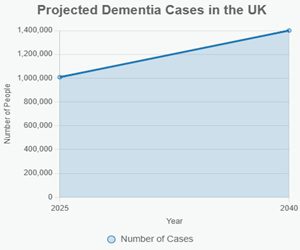
Approximately 982,000 people lived with dementia in 2024, with estimates for 2025 rising to around 1.01 million due to an aging population.
Types of Dementia and Percentages
While UK-specific breakdowns are limited, global patterns hold true here, with Alzheimer's disease dominating. The table below summarizes common types based on Alzheimer's Society and WHO data:
Type of Dementia Percentage of Cases
Alzheimer's Disease 60-70%
Vascular Dementia 10-20%
Dementia with Lewy Bodies 5-10%
Frontotemporal Dementia <5%
Mixed/Other 10-20%
Average Age of Diagnosis
The average age at diagnosis is approximately 80 years, though symptoms often emerge 3.5 years earlier, leading to delayed identification.
Average Duration Before Death
People typically survive 4-8 years post-diagnosis, though this varies by age at onset (e.g., 9 years if diagnosed at 60, 4.5 years at 85).
Cost to the Economy
Dementia cost the UK economy £42.5 billion in 2024, primarily through social care (77% of costs). This includes £7.1 billion in healthcare and significant unpaid family caregiving.
Projected Case Numbers and Costs to 2040
Projections indicate a rise to 1.4 million cases by 2040, driven by demographic shifts. Economic costs are expected to nearly double to £90 billion. The line chart below illustrates the projected growth in UK dementia cases from 2025 to 2040.
Dementia in Europe
Europe faces a rapidly growing dementia crisis, with higher prevalence in Western and Northern regions due to advanced aging demographics.
Current Number of People with Dementia
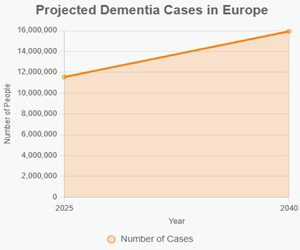
Around 11.5 million people lived with dementia in 2025 across the wider European region (including EU and non-EU members), up from 9.8 million in 2019.
Types of Dementia and Percentages
European data aligns with global estimates, with no significant regional variations reported:
Type of Dementia Percentage of Cases
Alzheimer's Disease 60-70%
Vascular Dementia 10-20%
Dementia with Lewy Bodies 5-10%
Frontotemporal Dementia <5%
Mixed/Other 10-20%
Average Age of Diagnosis
Similar to the UK, the average diagnosis age is about 80 years, with prevalence rising sharply after 75 (e.g., 8% in 75-79 age group).
Average Duration Before Death
Survival averages 4-8 years post-diagnosis, consistent with UK and global patterns.
Costs to the Economy
Direct and indirect costs for 11 major European countries exceeded €200 billion annually in recent estimates, with informal care comprising 40%. Continent-wide, costs are projected to rise proportionally with case numbers.
Projected Case Numbers to 2040
Cases are expected to reach 15.9 million by 2040, nearly doubling from early 2000s levels. The line chart below shows projected growth in European dementia cases.
Dementia in the USA
The USA has one of the highest absolute numbers of dementia cases, with stark racial disparities: Black Americans are twice as likely to be affected as Whites.
Current Number of People with Dementia
An estimated 7.2 million Americans aged 65+ lived with Alzheimer's dementia in 2025, representing about 11% of that age group.
Types of Dementia and Percentages
Type of Dementia Percentage of Cases
Alzheimer's Disease 60-70%
Vascular Dementia 10-20%
Dementia with Lewy Bodies 5-10%
Frontotemporal Dementia <5%
Mixed/Other 10-20%
Average Age of Diagnosis
The average age is 75-80 years, with 74% of cases diagnosed at 75+.
Average Duration Before Death
Post-diagnosis survival averages 4-8 years, though some live up to 20 years.
Cost to the Economy
Costs reached $384 billion in 2025 for health and long-term care, with unpaid family care valued at $413.5 billion annually.
Projected Case Numbers to 2040
Cases are projected to hit 10.5 million by 2040, en route to 12.7 million by 2050.
The line chart below depicts USA projections.

Global Dementia Figures
Globally, dementia is the seventh leading cause of death, with nearly 10 million new cases annually. Low- and middle-income countries bear 60% of the burden.
Current Number of People with Dementia
Over 66.5 million people worldwide had dementia in 2025, up from 57 million in 2021.
Types of Dementia and Percentages
Type of Dementia Percentage of Cases
Alzheimer's Disease 60-70%
Vascular Dementia 10-20%
Dementia with Lewy Bodies 5-10%
Frontotemporal Dementia <5%
Mixed/Other 10-20%
Average Age of Diagnosis
Typically around 80 years, as age is the primary risk factor.
Average Duration Before Death
Averages 4-8 years post-diagnosis, varying by type and health factors.
Cost to the Economy
Global costs hit $1.3 trillion in 2019, with 50% from informal care; projections reach $2.8 trillion by 2030.
Projected Case Numbers to 2040
Expected to surge to 108.5 million by 2040. The line chart below shows global projections, including intermediate points for context.
Highest Global Rates of Dementia
On a Global scale, we take a look at the top 20 highest rates of dementia per capita together with the estimated percentages for each population of over 65's. For the purposes of clear analysis we have only looked at countries with a minimum population in excess of 25 Million.
| Rank | Country | Rate per 100,000 | Est % 65+ |
|---|---|---|---|
| 1 | Japan | 2,640 | 30% |
| 2 | Italy | 2,390 | 25% |
| 3 | Germany | 2,340 | 24% |
| 4 | Canada | 1,680 | 20% |
| 5 | Spain | 1,570 | 22% |
| 6 | USA | 1,470 | 18% |
| 7 | France | 1,390 | 23% |
| 8 | South Korea | 1,350 | 19% |
| 9 | UK | 1,340 | 19% |
| 10 | Poland | 1,310 | 21% |
| 11 | Ukraine | 1,220 | 20% |
| 12 | China | 1,190 | 15% |
| 13 | Australia | 1,170 | 17% |
| 14 | Russia | 1,110 | 16% |
| 15 | Brazil | 829 | 11% |
| 16 | Turkey | 823 | 10% |
| 17 | Argentina | 765 | 12% |
| 18 | Venezuela | 741 | 9% |
| 19 | Colombia | 740 | 10% |
| 20 | Mexico | 700 | 9% |
All of the countries in the top 20 are classed as well developed countries each with respected medical facilities so it is expected that detection levels will be similar.
To assess which countries "perform better" (i.e., exhibit lower dementia rates relative to their elderly populations), we have calculated a normalised rate for each: Dementia Rate per 100,000 / % Population Over 65.
Whilst this metric isolates the implied burden on the over - 65 group, we know for fact rather than assumption that dementia primarily affects this demographic. Lower values indicate better relative performance (e.g., potentially due to better healthcare, lifestyle factors, or lower incidence in the elderly).
Key Findings
Top Performers (Lowest Normalised Rates): These countries have disproportionately lower per capita rates compared to their elderly share, suggesting more efficient outcomes for aging populations.
- France (60.4): Strong performer; high elderly % but low relative rate.
- Ukraine (61.0): Notably low despite regional challenges.
- Poland (62.4): Efficient given its aging demographics.
- Argentina (63.8): Stands out amongst Latin American nations.
- Australia (68.8): Balanced aging with controlled rates.
Bottom Performers (Highest Normalised Rates): Higher burden on elderly, possibly from genetic, environmental, or diagnostic factors.
- Germany (97.5): High rate amplifies with large elderly cohort.
- Italy (95.6): Similar to Germany; Mediterranean diet may help but not enough.
- Japan (88.0): World's oldest population drives elevated relative burden.