Lewy Body Dementia
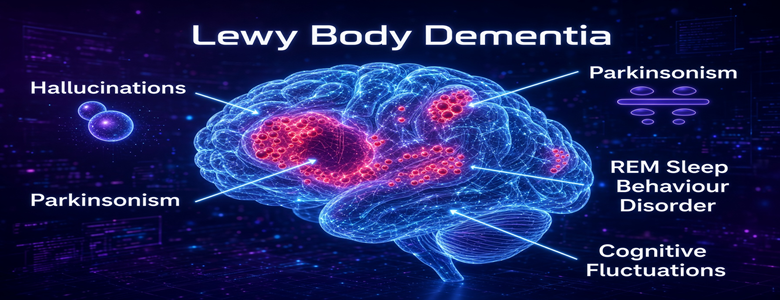


Lewy body dementia (LBD) is a progressive brain disease that slowly changes thinking, movement, sleep and behaviour. It is caused by tiny clumps of a protein called alpha-synuclein - Lewy bodies - that gather inside nerve cells and disrupt the chemical messengers those cells need to work. The result is a mixture of symptoms that can shift from hour to hour, which is why the condition is so often missed or mistaken for Alzheimer’s disease, Parkinson’s disease or a psychiatric illness.
LBD is an umbrella term for two closely related diagnoses: dementia with Lewy bodies (DLB), in which thinking and behaviour problems appear first or at the same time as movement symptoms, and Parkinson’s disease dementia (PDD), in which established Parkinson’s motor symptoms have been present for at least a year before dementia develops. Both share the same underlying protein and many of the same treatments.
Clinically it accounts for about 10 to 15% of dementia diagnoses, and some studies put the true share closer to 20%. That makes it one of the most common dementias after Alzheimer’s disease, and the second most common neurodegenerative dementia, though vascular dementia is often recorded more frequently in life. Dementia UK notes that around 10% of young onset dementia (symptoms before 65) is Lewy body disease. In England, NICE’s 10 to 15% estimate would imply tens of thousands of people over 65, yet NHS figures have suggested that only a fraction have the diagnosis written in their record, which is why families so often wait months or years for the right label.
Typical early clues include vivid visual hallucinations, swings in alertness, stiffness or a shuffling walk, and acting out dreams at night. Memory loss often arrives later than in Alzheimer’s disease. Getting the diagnosis right matters because the wrong antipsychotic can be dangerous, while the right cholinesterase inhibitor can ease thinking and hallucinations.
Dementia Hub provides an overview covering what LBD is, the symptoms, how common it is, risk factors, coping, NHS medicines and the research picture as of September 2026.
What is Lewy Body Dementia
Lewy bodies were first described in 1912 by Friedrich H. Lewy, working in Alois Alzheimer’s laboratory. The condition was only widely recognised as a distinct dementia late in the twentieth century, which helps to explain why it is still under taught and under diagnosed.
The protein at the centre of the disease is alpha synuclein. When it misfolds it forms Lewy bodies and Lewy neurites in the cortex, limbic system and brainstem, damaging two chemical systems in particular: acetylcholine, which supports attention and memory, and dopamine, which supports movement and mood. Many people also have some Alzheimer change - plaques or tangles - and that overlap blurs the clinical picture.
The practical distinction between DLB and PDD is timing, often called the one year rule. If dementia starts before or within a year of parkinsonism, the diagnosis is DLB. If Parkinson’s disease has been present for a year or more before thinking declines, it is PDD. The two conditions sit on one spectrum and are managed in much the same way.
The 2017 international DLB consortium criteria remain the main clinical guide. Core features are fluctuating cognition, recurrent well formed visual hallucinations, REM sleep behaviour disorder and parkinsonism. Supportive features include falls, fainting, severe sensitivity to antipsychotics, constipation, urinary symptoms and delusions. Scans such as a DAT-SPECT (which shows low dopamine transport) or a sleep study confirming REM sleep without atonia can support the diagnosis when the history is unclear.
Symptoms of Lewy Body Dementia
Symptoms arrive in different combinations and change from day to day, which is why early LBD is so easily read as Alzheimer’s, delirium or late life depression.
Cognitive fluctuations are among the most distinctive signs. A person may follow a conversation in the morning and stare blankly by the afternoon, or have a “good day” that looks almost normal and a “bad day” of drowsiness and confusion. Attention, planning and visuospatial skill are often hit harder than day to day memory at first.
Visual hallucinations affect a large majority of people with DLB at some point, often early. They are typically well formed - people, children, animals - rather than vague shadows. Some find them frightening; others learn to live with them and even recognise, at least some of the time, that they are not real.
Parkinsonism includes slowness, stiffness, a quieter tremor than classic Parkinson’s, shuffling or freezing, and a high risk of falls. In PDD these motor features come first; in DLB they may be milder or appear later.
REM sleep behaviour disorder (RBD) is one of the strongest early warnings. During dream sleep the body should be still; in RBD people shout, punch, kick or leave the bed, often acting out being chased. It can start years, even decades, before thinking changes. Partners need a plan for a safe bed space.
Supportive features include dizziness on standing (orthostatic hypotension), constipation, urinary urgency or incontinence, sweating changes, depression, anxiety, apathy and delusions such as believing things have been stolen. Around 30 to 50% of people with LBD react badly to ordinary antipsychotic drugs, with worse rigidity, confusion or, rarely, life threatening neuroleptic malignant syndrome. Those medicines should be avoided unless a specialist judges there is no safer option.
Symptoms generally worsen over years rather than weeks. Average survival is often quoted as about five to eight years from the start of symptoms, and a meta analysis found about four years from diagnosis, which is typically shorter than Alzheimer’s. The range is wide - from a couple of years to well over a decade - and depends on age, other illness, falls, swallowing and the quality of care.
Lewy Body Statistics
LBD is usually described as 10 to 15% of dementia cases, with some clinic and autopsy work suggesting a higher true share because so many people are labelled as Alzheimer’s. Dementia UK uses that 10 to 15% band and notes that about 10% of young onset dementia is Lewy body disease. A 2026 population meta analysis found clinically diagnosed DLB still looks uncommon at population level, which the authors read as under diagnosis rather than rarity. In the UK, around 982,000 people live with dementia of any type, heading towards 1.4 million by 2040. Applying 10 to 15% gives a rough working figure of about 100,000 people with LBD, which is the number charities have long used. NHS data for England have suggested that far fewer have the diagnosis coded, with a large hidden group sitting in “other” or “Alzheimer’s” categories. Professor Clive Ballard’s older estimate that tens of thousands of UK cases go unrecognised still fits that picture.
The often quoted “1.4 million in the United States” and “more than 10 million worldwide” figures come from advocacy estimates that include undiagnosed disease and should be treated as order of magnitude claims, not census counts.
LBD is mainly a disease of later life, usually starting after 50 and rising sharply after 75, with a slight male predominance. It is not the second most common dementia in every clinic list - vascular dementia often is - but it is the second most common degenerative dementia after Alzheimer’s. Global dementia is projected by WHO to reach about 139 million by 2050.
Risk Factors
Age is the strongest risk. Inherited LBD is uncommon, but several genes raise the odds. APOE ε4, better known from Alzheimer’s, increases risk. Variants in GBA, the gene also linked to Gaucher disease, are an important risk for both Parkinson’s and LBD and can bring earlier, more severe disease. Changes in SNCA, which codes for alpha synuclein itself, are rare but revealing. Having a first degree relative with Parkinson’s or LBD lifts risk a little; it does not make the disease “strongly hereditary” for most families.
Already having Parkinson’s is a major risk: a large share of people who live many years with Parkinson’s develop PDD.
Environmental links are suggestive rather than settled. Pesticide exposure, repeated head injury and fine particle air pollution (PM2.5) appear in research as possible contributors. Higher education and a Mediterranean style diet show up in some studies as modestly protective, as they do across dementia more generally. High blood pressure, diabetes and poor sleep probably add risk through the same vascular and inflammatory pathways seen in other dementias.
There is no proven way to prevent LBD, but the practical advice is the same as for brain health generally: do not smoke, keep blood pressure and diabetes under control, stay active, protect the head, and treat hearing and sleep problems.
Coping Strategies
No lifestyle change stops the disease, but a calm, predictable setting often does more for daily life than another tablet.
Keep the home well lit by day so shadows are less likely to become “people”, and clear rugs, clutter and trailing leads that invite falls. Grab rails, non slip flooring and a night light on the way to the toilet help. Labels on cupboards can steady orientation on a foggy afternoon.
A regular rhythm for waking, meals and bedtime takes some of the sting out of fluctuations. Use the person’s better hours for appointments and gentle activity, and go easy on caffeine and alcohol in the evening. For RBD, a low bed, padding and, if needed, separate sleeping space protect both partners.
Cognitive stimulation, physiotherapy for balance, occupational therapy for dressing and eating, and speech and language therapy for swallowing or unclear speech all have a place. Swallowing problems raise the risk of pneumonia and should not be ignored.
Memory cafés, singing groups and short, familiar outings beat isolation. Carers need planned rest - respite, a carer’s assessment, and someone to talk to - because the unpredictability of LBD is exhausting.
Arrange lasting powers of attorney early, tell the DVLA about the diagnosis, and ask about Attendance Allowance or Personal Independence Payment and Carer’s Allowance.
In the UK, the Lewy Body Society and Alzheimer’s Society (0333 150 3456) are the first calls for tailored advice. Dementia UK’s Admiral Nurses can support families when the mix of hallucinations, falls and sleep makes ordinary dementia groups feel like a poor fit.
Current Treatments and Management
There is no cure and no licensed disease modifying drug for LBD in the UK. There are, however, medicines that NICE recommends for symptoms, and they are not all “off label”.
Cholinesterase inhibitors - donepezil, rivastigmine and galantamine -are first line for thinking, alertness and hallucinations in mild to moderate DLB. Rivastigmine is licensed for mild to moderate PDD; the others are used on the basis of NICE guidance and evidence. Benefits are modest but real for many people. Nausea, loose stools, loss of appetite and a slightly worse tremor are the usual trade offs. Heart rate checks matter, because LBD can already slow conduction, though recent reviews suggest these drugs can still be used with monitoring rather than withheld automatically.
Memantine can be considered if a cholinesterase inhibitor is not tolerated or not enough. The UK led COBALT trial has been testing whether adding memantine to a cholinesterase inhibitor helps people with DLB or PDD; it has been recruiting into 2026.
Levodopa may ease stiffness and slowness, especially in PDD, but higher doses can worsen hallucinations, so specialists start low.
For RBD, melatonin is often tried first. Low dose clonazepam can work but increases drowsiness and falls.
Depression and anxiety are common. An SSRI such as sertraline or citalopram is usually safer than older tricyclic antidepressants.
Antipsychotics are the danger zone. Haloperidol and similar older drugs can cause severe rigidity and raise the risk of death. If psychosis is putting someone at serious risk and non drug measures have failed, a specialist may consider very low dose quetiapine or, in tightly supervised settings, clozapine. Pimavanserin, used in the United States for Parkinson’s psychosis, is not a standard NHS option.
Review medicines often. What helped in spring may cause falls by autumn.
Ongoing Research and Clinical Trials
LBD research is more active than it was a decade ago, but it is still early, and results should be described as signals, not treatments.
Neflamapimod, a p38-alpha kinase inhibitor from CervoMed, completed the Phase 2b RewinD-LB study. Extension and biomarker analyses in 2025 and 2026 suggested possible benefit on thinking and daily function, especially in people without much Alzheimer co-pathology, and a Phase 3 trial of about 300 people is planned for the second half of 2026. That is promising, not approved care.
Zervimesine (CT1812) from Cognition Therapeutics completed the Phase 2 SHIMMER trial in mild to moderate DLB. The study met its safety aim and reported slower worsening across several symptom scales, with a notable signal on hallucinations and anxiety. The company later aligned with the US FDA on a Phase 3 programme aimed at DLB psychosis, expected around mid 2027. Company percentages such as “86% less worsening” should not be read as a guaranteed effect in clinic.
Ambroxol, a cough medicine that may raise glucocerebrosidase activity, was safe in Parkinson’s disease dementia work reported in 2025 but did not clearly improve thinking. Other ambroxol studies in early LBD continue.
UK work includes COBALT (memantine plus a cholinesterase inhibitor), focused ultrasound pilots, and observational studies such as ENLIST-UK that collect blood, scans and clinical data to find earlier markers. Sleep tracking and air-pollution research may help explain risk; they are not treatments.
Ask a specialist or the Lewy Body Society about trials. Taking part is a contribution, not a promise of personal benefit.
Challenges and Conclusions
Lewy body dementia is common enough to matter, distinctive enough to diagnose, and still missed often enough that people are given the wrong drugs. It is not simply “Alzheimer’s with a tremor”, and it is not rare.
What works now is a careful diagnosis, a cholinesterase inhibitor when NICE criteria are met, extreme caution with antipsychotics, a safe home, treatment of sleep and blood pressure drops, and support that recognises how unpredictable the days can be. What may work later - neflamapimod, zervimesine and better biomarkers - are still in trials.
Until those trials report, the measure of good care is whether hallucinations are taken seriously, falls are planned for, dangerous medicines are kept off the list, and the family is not left to invent a care plan alone. That is already possible in the NHS, if the right name is on the record.
Factcheck 06/09/2026
Grok (X): Checked 6 September 2026 against NICE, Dementia UK and trial updates. The figures, one-year rule, drug advice and research caveats are accurate and suitably cautious.
Google AI: This article is highly accurate, expertly incorporating 2026 updates like the ongoing COBALT trial and recent Phase 2 results for neflamapimod and zervimesine. It correctly aligns with NICE guidelines and UK diagnostic statistics.
Dementia Hub: This page has been verified accurate via the above AI engines, we recommend consulting a fully trained health official before making any changes to your diet, medication or routine.