What is Mixed Dementia
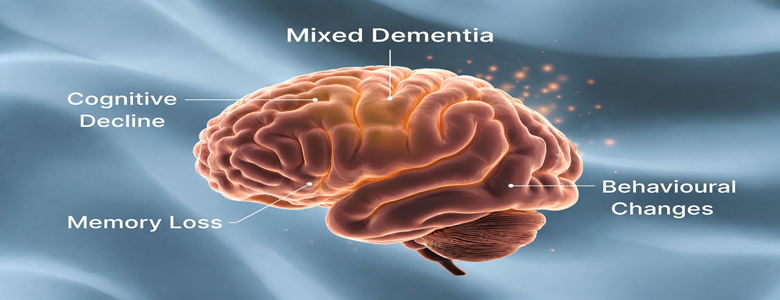


Mixed dementia is the name given when memory and thinking problems come from more than one disease process at the same time. The combination most often described in clinics is Alzheimer’s disease with vascular damage. Alzheimer’s involves amyloid plaques and tau tangles that disrupt nerve cells. Vascular dementia follows reduced blood flow from damaged or blocked vessels, small strokes or disease of the brain’s small arteries. Other pairings are also common. Alzheimer’s can sit alongside Lewy body disease, in which clumps of alpha-synuclein affect thinking, alertness, movement and perception. Vascular damage can combine with Lewy body changes. In later life a further pathology, limbic-predominant age related TDP-43 encephalopathy (LATE), often joins Alzheimer’s and is easy to mistake for it.
For years research treated dementia as if each person had one “pure” disease. Autopsy work from the 1990s onwards, including the Nun Study, showed that this is often untrue. In older brains, several protein and vessel changes usually sit together. After about 80 years of age, almost no one has only a single pathology. That finding has changed how specialists think about symptoms, tests and treatment. Age, genes, blood vessel health and lifestyle all play a part.
Diagnosis is still difficult because the symptoms overlap. Forgetfulness, slowed thinking, mood change and unsteadiness can come from more than one cause. Scans, blood tests and a careful history help, but they do not always separate every strand in life. As populations age, mixed disease becomes more important. It raises the cost of care and the load on families, who often face a faster decline and more physical illness than in a single-type dementia.
This Dementia Hub overview sets out the symptoms to watch for, how common mixed dementia is, how people can manage day to day, and what treatments and trials now offer. The thread running through it is simple. Mixed dementia needs a joined up plan: medicines where they help, tight control of heart and vessel risks, practical support and honest talk about what we still cannot fix.
Symptoms of Mixed Dementia
Symptoms depend on which diseases are present and which parts of the brain are most affected. The mix often looks worse than one disease alone and can progress more quickly. No two people follow the same pattern.
Thinking Problems
These are often the first changes families notice.
Memory loss is typical when Alzheimer’s pathology is strong. Recent conversations, appointments and meals are forgotten. The same question may be asked again and again.
Planning and decision making suffer when vascular damage is marked. Bills, shopping lists, recipes and travel plans become hard to organise. People may freeze over simple choices.
Sense of space and direction can fail in Alzheimer’s or Lewy body disease. Distances are misjudged. Familiar streets feel strange. Driving and walking outdoors become unsafe.
Thinking can slow when white matter vessel damage is present. Conversations feel hard to follow. Television plots slip away. Word finding trouble is common and can leave people quieter in company.
Movement Problems
Physical changes raise the risk of falls.
Lewy body involvement can bring slowness, stiffness or a tremor, a little like Parkinson’s disease. Buttons, cutlery and handwriting become awkward.
Vascular damage, especially in deep connecting fibres, can cause a short shuffling walk, poor balance and hesitation on stairs.
A stroke linked to vascular disease may leave sudden weakness on one side. That needs urgent medical care.
Handrails, well fitting shoes and a walking aid can reduce harm. A falls review with a GP or physiotherapist is worth asking for.
Mood and Mental Health Changes
These signs often distress families more than memory loss.
Depression and loss of interest are common across mixed types. Hobbies drop away. The person may seem flat rather than sad.
Visual hallucinations are a clue to Lewy body disease. People or animals may appear real to the person seeing them. Calm reassurance usually works better than argument.
Anxiety, irritability and sudden snaps of temper can come from frustration, pain, infection or the brain changes themselves.
False beliefs, such as fearing theft or misidentifying a spouse, occur in some Alzheimer’s and Lewy body mixes. Gentle redirection is safer than confrontation.
Body Function and Sleep Problems
REM sleep behaviour disorder, in which people act out dreams, points towards Lewy body disease. Bed partners can be hurt. A safer bedroom and specialist advice help.
Drops in blood pressure on standing, dizziness and bladder urgency or incontinence can come with vascular or Lewy body disease. Hydration, slow standing and planned toilet trips reduce accidents.
Changing Alertness
Marked swings between a clear day and a confused day are a hallmark of Lewy body involvement. Plans need to be flexible.
Course and outlook vary. Vascular events can cause sudden steps down. Alzheimer’s tends to slide more steadily. Survival after diagnosis is often quoted as four to eight years, but this is only an average. Extra heart disease, stroke risk and frailty can shorten that span. Mixed pathology on autopsy is found in well over half of older people with dementia, which is why early assessment still matters even when the label is not neat.
Mixed Dementia Statistics
Figures depend on whether you count clinical labels or what is found in the brain after death.
Clinically, mixed Alzheimer’s and vascular dementia is often put at about 10 per cent of diagnosed dementia in the UK, with a wider international range of roughly 10 to 30 per cent. That understates the true overlap. Neuropathology studies show multiple disease processes in a large share of people with dementia, and in the oldest old this is the rule rather than the exception. Combinations of Alzheimer’s changes with vessel disease, Lewy bodies or TDP-43 (LATE) are all common. LATE alone is frequent after 85 and is present in a high proportion of people who also have Alzheimer’s.
Worldwide, the World Health Organization estimated that 57 million people were living with dementia in 2021, with nearly 10 million new cases each year. Earlier WHO projections put the total at about 78 million by 2030 and 139 million by 2050. More than 60 per cent of people with dementia live in low and middle income countries.
In the UK, Alzheimer’s Society still estimates that about 982,000 people are living with dementia, with a rise to 1.4 million by 2040. England’s recorded diagnosis rate in people aged 65 and over remains around two thirds of those thought to have the condition. Vascular dementia is often listed as the second most common clinical type, but many of those cases overlap with Alzheimer’s changes and would be classed as mixed if every pathology were visible in life.
In the United States, more than seven million people aged 65 and over live with Alzheimer’s dementia. Autopsy series often find mixed disease in around one in five to one in two brains, depending on age and how strictly “mixed” is defined. Community studies tend to find more overlap than memory clinic series.
Is the share of mixed cases rising? Ageing populations make multiple brain changes more likely. Better scans and blood tests also reveal combinations that used to be labelled as “pure” Alzheimer’s. Incidence of dementia has fallen in some high income countries because of better education and heart health, but the number of people living with mixed disease is still expected to grow as more people reach very old age.
Risk Factors
Some risks cannot be changed. Age is the strongest. Risk rises sharply after 65. The APOE ε4 gene increases the chance of Alzheimer’s pathology, which then often sits with vessel or Lewy body changes. Women live longer on average, so more women develop mixed disease. Past head injury adds risk over time.
Many risks can be lowered. The 2024 Lancet Commission concluded that action on 14 modifiable factors could theoretically prevent or delay about 45 per cent of dementia cases worldwide. The list is: less education in early life, hearing loss, high blood pressure, smoking, obesity, depression, physical inactivity, diabetes, excess alcohol, traumatic brain injury, air pollution, social isolation, untreated vision loss and high LDL cholesterol. The last two were added in 2024.
For mixed dementia the vascular cluster is especially important. High blood pressure damages small brain vessels. High LDL cholesterol and diabetes injure arteries. Smoking narrows vessels and adds toxins. Midlife obesity, heavy drinking, loneliness and dirty air all chip away at reserve.
Useful steps overlap with good heart care. Aim for at least 150 minutes a week of moderate activity, such as brisk walking, swimming or cycling. A Mediterranean style pattern of fruit, vegetables, whole grains, fish, nuts and olive oil supports blood pressure and cholesterol. Keep blood pressure, sugar and lipids under review with a GP. Stop smoking. Keep alcohol within 14 units a week. Treat hearing and vision problems. Stay socially connected. Keep the mind busy. Sleep seven to nine hours if you can.
No single habit is a guarantee. Together they improve the odds, particularly against the vascular half of mixed disease. Midlife is the best time to start, but later change still helps. As always Dementia Hub strongly recommends speaking to a GP before any shifts in medicine, routine or exercise.
Diagnosis
Mixed dementia is hard to diagnose because symptoms blend. Doctors begin with the person and family: what has changed, over what time, and what else is going on in the body. Depression, delirium, vitamin B12 deficiency, thyroid disease, sleep apnoea and side effects of medicines all need to be ruled out.
Standard frameworks still help. DSM-5 describes the level of cognitive impairment. Vascular criteria such as NINDS-AIREN look for stroke and vessel signs. The Alzheimer’s Association’s 2024 DETeCD-ADRD guidance asks clinicians to set out three things: how severe the thinking problem is, which symptoms stand out, and which brain diseases are likely. The 2024 revised Alzheimer’s criteria also accept that copathologies are usual in older people. Clinical criteria for possible LATE, published in 2025, try to flag TDP-43 disease when memory loss is severe and the hippocampus is very small, even if amyloid and tau are also present. LATE still cannot be confirmed in life with a single test.
Useful tools include:
- Brain scans. MRI shows infarcts, white matter damage, bleeds and shrinkage. It is the workhorse for the vascular part of mixed disease. Amyloid PET can confirm Alzheimer’s plaques. Tau PET and FDG-PET add pattern information. AI tools are being tested to read scans faster, but they do not replace a clinician.
- Thinking tests. The Montreal Cognitive Assessment (MoCA) often picks up mixed and vascular problems better than the shorter Mini Mental State Examination (MMSE). Tests of attention, planning and visuospatial skill help when Lewy body or vascular disease is suspected.
- Biomarkers. Spinal fluid amyloid and tau, and now blood tests such as p-tau217, can show Alzheimer’s pathology. Blood tests are entering specialist clinics and research studies in the UK, with wider NHS use still several years away. They do not prove that Alzheimer’s is the only cause. Vascular damage and Lewy body or TDP-43 disease can still sit beside a positive Alzheimer’s blood test. Markers such as neurofilament light show general injury rather than one disease.
General health checks. Blood pressure, sugar, cholesterol, heart rhythm and, where needed, sleep studies often explain part of the picture.
Misdiagnosis is common. Many people are first told they have only Alzheimer’s or only vascular dementia. Specialist assessment using scans and biomarkers improves accuracy, but access is uneven. Under diagnosis remains a problem, particularly in some minority groups and in people who never reach a memory clinic.
If mixed dementia is suspected, ask for a memory clinic referral. An earlier, more complete picture makes treatment and planning easier.
Treatments and Clinical Trials
There is no medicine designed only for mixed dementia. Care aims to ease symptoms, protect blood vessels and avoid harm. People often take several drugs, so reviews matter. Those with Lewy body features can react badly to some antipsychotics and to medicines with strong anticholinergic effects.
Medicines for Memory and Thinking
Donepezil, rivastigmine and galantamine raise acetylcholine. NICE recommends them for Alzheimer’s disease and, off-label in some cases, for dementia with Lewy bodies and Parkinson’s disease dementia. For vascular dementia they should be considered only if Alzheimer’s, Parkinson’s dementia or Lewy body disease is also suspected - which is exactly the situation in many mixed cases. They can help memory, attention and, in Lewy body disease, hallucinations in some people. Nausea, loose stools and vivid dreams are common at the start. A low dose, built up slowly, is kinder.
Memantine is used in moderate to severe Alzheimer’s and can be added to a cholinesterase inhibitor. It is sometimes considered in Lewy body disease if those first drugs are not tolerated. The UK COBALT trial is testing whether adding memantine to a cholinesterase inhibitor helps people with dementia with Lewy bodies or Parkinson’s disease dementia. Recruitment was still open into 2026; results are not yet published.
Tackling Heart and Blood Issues
This is the part of mixed dementia where everyday medicine can still change the course. Blood pressure treatment, statins, diabetes care and, where indicated, antiplatelet drugs after stroke all protect the brain’s vessels. Targets should be individual. Very low pressure can increase falls. Blood thinners need a careful bleed risk review, especially if anti amyloid treatment is ever considered.
Help for Mood and Behaviour
Sertraline and similar antidepressants may help depression. They should be started low and reviewed.
Antipsychotics are a last resort for severe agitation or distressing psychosis. Risperidone has a short term UK licence in Alzheimer’s related aggression, but stroke and death risk rise, so use must be brief and watched. In Lewy body disease, older antipsychotics can cause severe sensitivity. Quetiapine is sometimes used cautiously. Pimavanserin is licensed in the United States for Parkinson’s disease psychosis and has been studied in related conditions; it is not a routine UK mixed dementia treatment.
Melatonin is often tried first for REM sleep behaviour disorder. Low dose clonazepam is used when needed, with fall risk in mind.
Beyond Pills: Other Ways to Help
Exercise, social contact and mentally engaging activity support mood and function. Cognitive stimulation therapy has evidence in mild dementia. Speech and language therapy can help word finding. Occupational therapy and simple home changes cut falls. Carer support, dementia cafés and planned respite make the long haul more bearable. A diet that favours plants, fish and unsaturated fats supports vessel health.
Exciting Research and Trials
No treatment stops mixed dementia. Most drug trials still enrol people with relatively “pure” early Alzheimer’s and confirmed amyloid, and they often exclude heavy vascular disease because of bleed risk.
Lecanemab and donanemab can slow early Alzheimer’s a little in selected people. They are not approved as mixed dementia drugs. People with significant cerebrovascular disease or cerebral amyloid angiopathy may face higher risk of ARIA (brain swelling or small bleeds). They are not, as of September 2026, available on the NHS.
The UK LACI-3 trial is still recruiting. It tests cilostazol, isosorbide mononitrate, both or neither after lacunar (small vessel) stroke, with thinking and independence as key outcomes. Earlier LACI-2 work suggested possible benefits for cognition and dependency, which is why the larger study is running. It has not yet reported Phase 3 results.
Neflamapimod showed signals in dementia with Lewy bodies in the RewinD-LB programme. A Phase 3 trial is planned for the second half of 2026. Importantly, that programme aims to exclude people with clear Alzheimer’s copathology, so it is not a mixed Alzheimer’s / Lewy body study.
Blood tests for amyloid, tau and, in research settings, other proteins are making it easier to see when more than one disease is present. That should improve trial design. Stem cell and CRISPR work remain early. They are not near routine care.
Combination treatment - vessel protection plus symptom drugs, and perhaps one day anti-amyloid or anti-tau medicine in carefully chosen people - is the direction of travel. Anyone interested in a trial should ask their memory clinic or look at the NIHR Be Part of Research site.
Conclusions and the Future
Testing will keep improving. Blood biomarkers and better MRI reading should make mixed and LATE related disease easier to suspect in life, though 95 per cent accuracy is a hope, not a present fact.
Treatment research is splitting into two tracks: drugs that clear or quiet Alzheimer’s proteins, and drugs or risk factor care that protect small blood vessels. Neither track yet offers a mixed dementia cure.
Prevention still has the largest proven reach. The 2024 Lancet Commission estimate that 14 factors account for about 45 per cent of cases is the figure to use, not the older 2020 list.
Carers need more than leaflets. Flexible respite, clear diagnosis and help with behaviour and sleep make the difference between coping and crisis.
Mixed dementia is not a rare extra category. In older age it is often the reality behind a single clinic label. Memory loss, slowed planning, hallucinations or an unsteady walk can arrive together. Care has to be personal. Cholinesterase inhibitors and memantine help some people when Alzheimer’s or Lewy body disease is part of the mix. Blood pressure, cholesterol and diabetes care protect the vascular half. Lifestyle change is not a slogan; it is one of the few tools that can still shift risk.
As more people live into their eighties and nineties, mixed disease will become harder to ignore. Better tests, fairer access to memory services, vessel-focused trials and support for families are the practical next steps. Doctors, researchers and carers will get further by treating the whole picture than by waiting for a single miracle drug.



Factcheck 07/09/2026
Grok (X): The article is highly accurate as of 7 September 2026. Clinical and autopsy figures, Lancet risks, NICE prescribing, LATE criteria, and named trial statuses check out, with only cautious wording on averages.
Google AI: The Dementia Hub mixed dementia guide is highly accurate and aligns with current medical standards. It correctly details co-pathologies, diagnostic criteria, and the 2024 Lancet Commission's 45% preventable risk factors.
Dementia Hub: This page has been verified accurate via the above AI engines, we recommend consulting a fully trained health official before making any changes to your diet, medication or routine.